How to beat nature deficit disorder if you’re a city-dwelling ecologist with power tools

Jenny escaping the city to regain her sanity at the cabin she built in Wisconsin. (photo: Tona Williams)

Jenny escaping the city–and humans–to regain her sanity at the cabin she built in Wisconsin. (Photo: Tona Williams)

This month, Jenny Carney is building a Scandinavian cabin in her Chicago West Loop office. Why? Because nobody could tell her not to and because she wanted to feel closer to nature in a city of almost 3 million people. This does not surprise me as I’ve only known Jenny for a couple of years and she’s already convinced me to:

  • dig up a garden for her amid the swarming of some terrible, horrible bugs
  • go on a weekend-long fly fishing trip
  • buy a timeshare for a yet-to-be-constructed yurt
  • build hotels for bees
  • round up about 1,000 used bricks to use as an outdoor patio floor for her property in Wisconsin (thank you to all who contributed–I will likely pester you for more)
  • take a bird watching class
  • hike through a state park after convincing me to also buy purple hiking boots
  • bike 35 miles up and down hills all day long in unrelenting rain to look at barns
  • pick her up a 10” Craftsman miter saw to help build this office cabin
  • …and then hand sand down all the walls of this office cabin
  • (as you might guess, this list is hardly exhaustive)
photo 4

The Scandinavian cabin in progress. It’s tricky to get a good photo because of the giant mushroom column used to support this converted warehouse space, but you get the idea. The casement window is a reclaimed window she purchased at the Rebuilding Exchange.
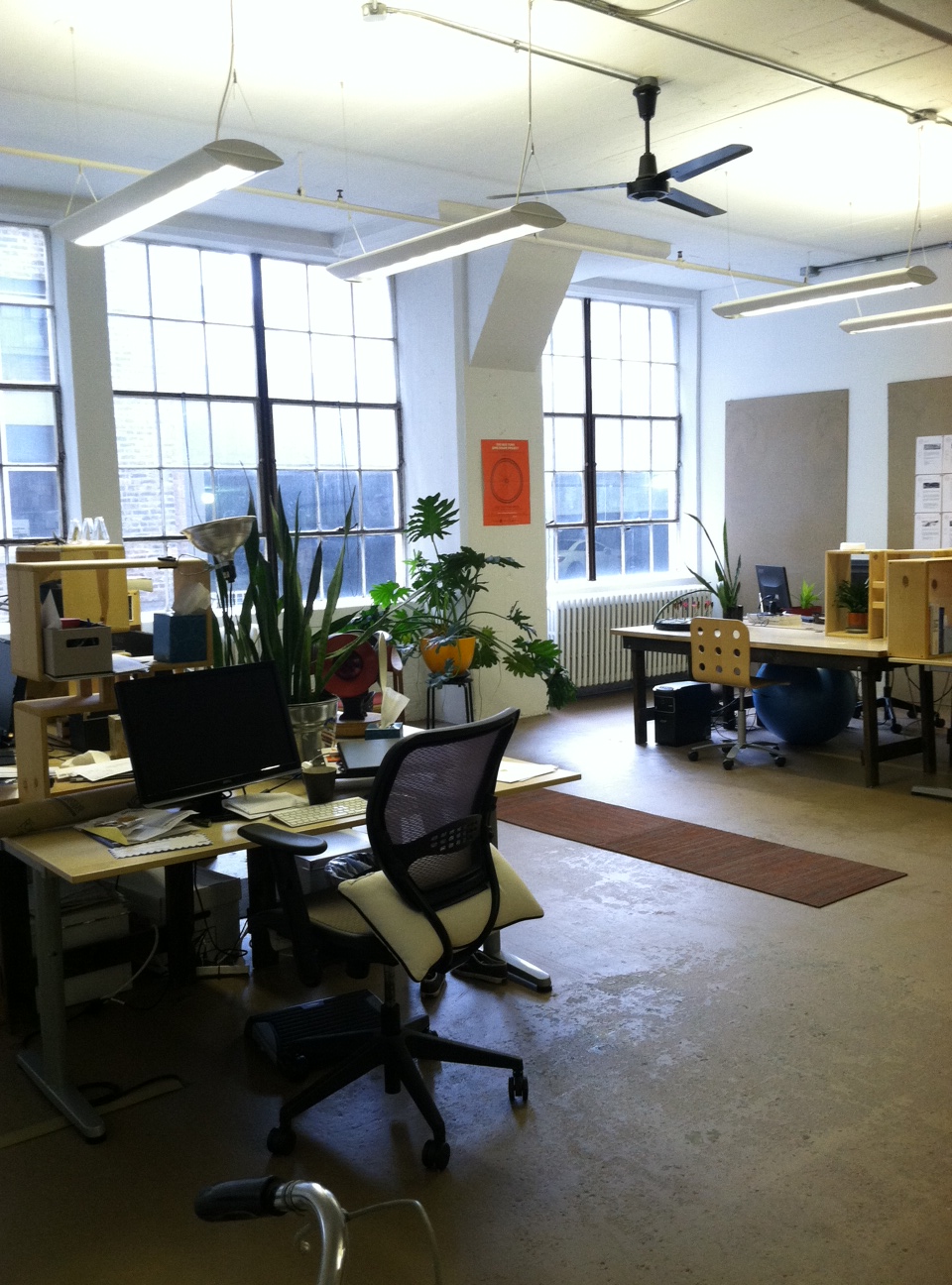
Jenny built the desks and other storage items in the office and brought in a lot of her own furnishings for the space.

Jenny built the desks and other storage items in the office and brought in a lot of her own furnishings for the space.


She also introduced me to a phenomenon called “nature deficit disorder” when she lent me a book called Last Child in the Woods by Richard Louv last year, which I’ve managed to not return because it completely floored me and because I’m lousy that way. Nature deficit disorder is not an official medical condition, but it takes about five seconds to realize that it should be. In a nut shell, the book discusses the alarming rate of sickness, stress, aggressiveness, and obesity with kids in the U.S. and attributes this, in large part, to the fact that they are spending almost zero time running around outside. This was later confirmed when I worked on a project interviewing folks who work in and with our local forest preserves and who talked at length about how astonishingly disconnected kids are from nature. For example, some high schoolers believe there are lions and tigers living in the trees, and the majority were completely terrified of our woods in general, which don’t exactly emulate the enchanted forest of Brothers Grimm fairytales. Adults may be slightly less intimidated by nature (and I stress might, as I know some who would crumple if they didn’t have heated leather seats to lounge on while resting), but you can add heart disease, stroke, Type 2 diabetes, certain kinds of cancer, and no doubt depression to that list of health concerns related to a lack of exercise and frolicking about.

Cutting down wood on the weekend to create furniture for the inside of the office cabin.

Cutting down wood on the weekend to create furniture for the inside of the office cabin.

Anyway, Jenny figured all this out much earlier than I did. She grew up in rural Wisconsin and was/is an ecologist. She’s in love with systems, processes, data analysis, hypothesizing, and being outside away from people. Working as a field ecologist, she says, required more ingenuity, physicality, wits, and schooling than any other job she’s had.

photo 3

Seating for the office cabin, which has built in storage underneath and which was precisely calculated to ensure that it was long enough to allow for daytime work naps for its designer, naturally.
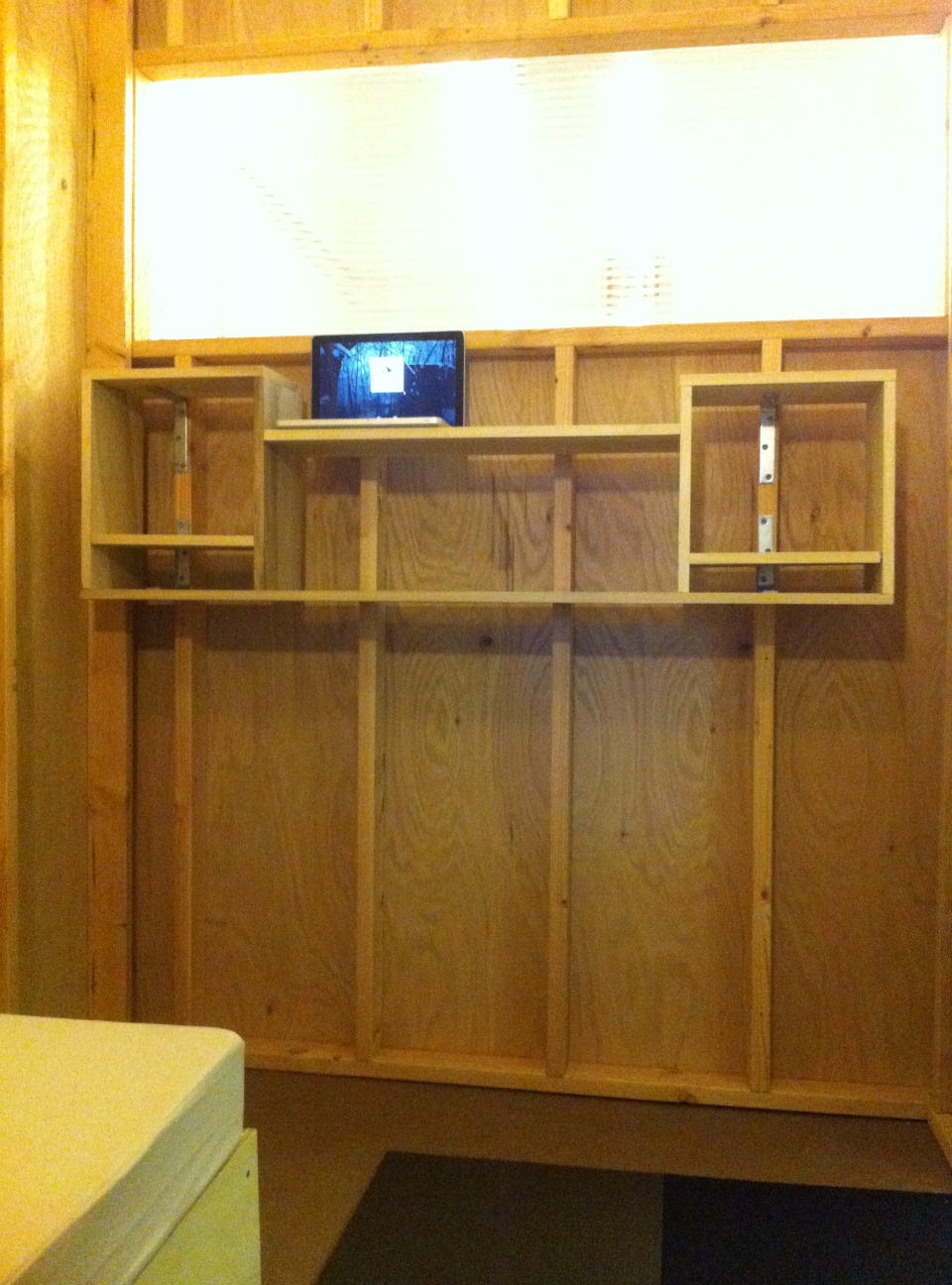
A "standing desk" she designed and built according to the varied heights of herself and her employees.

A “standing desk” she designed and built according to the varied heights of herself and her employees.


She eventually stumbled into green building, which provided an intriguing opportunity that put her at an intersection between environmental science, business, development, society, urban planning, and a number of other related fields. Dealing with the built environment was inviting because it is more tangible in a certain sense, than working as an ecologist documenting the natural world in decline. This career shift ultimately lead her to Chicago in 2007, where she opened up a Midwestern branch for an environmental consulting business.

Some essentials on the land.

Some essentials on the land: Thomas Jefferson study materials and a cordless power drill (no ma’am, no electricity).

The Carney maple syrup factory. Jenny's dad is a retired construction foreman and helped with the construction of Xanadu.

The Carney maple syrup factory. Jenny’s dad, a retired construction foreman, passed on his intense love of chores and also helped with the construction of Xanadu.


But, alas, the hustle and bustle of the city isn’t always ideal for someone who likes to think about the mating habits of bugs and who can explain how and why the breeze is blowing, so pretty much on a whim, she purchased several acres in the Driftless Area of Wisconsin in 2009 and named the land “Xanadu.” This was obviously cheaper than buying land in the city, and it was beautiful, geologically unique, and a reasonable enough distance from Chicago that weekend visits were feasible. She needed some shelter, however, so over a long weekend she constructed a 150 SF shed and an outhouse with a composting toilet with her dad, who is a retired construction foreman. Jenny was the designer, financier, and unskilled labor. He was the skilled labor with engineering prowess. She also described him as “exceedingly crafty,” which I believe, as he has constructed some kind of steampunk manifestation of a maple syrup factory according to pictures I’ve seen, along with an entire house that he continually builds more and more outbuildings around to stay busy since retiring. Jenny felt this project would be a welcome diversion for him.
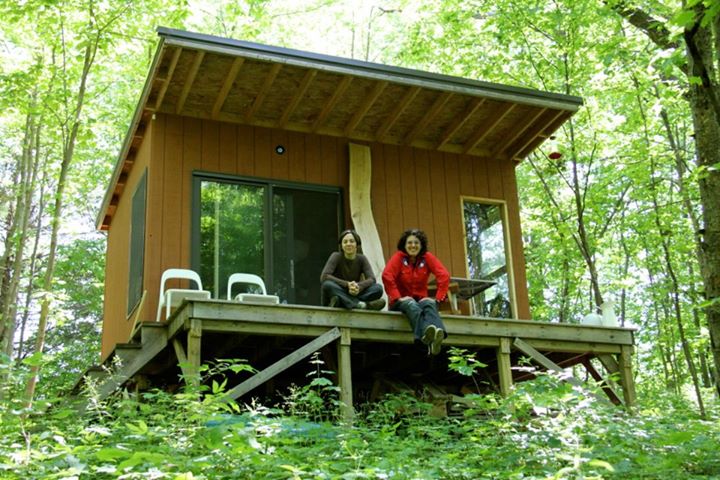
Xanadu, post-paint job, furniture and rain barrel installation. It's ever a work in progress.

Xanadu, post-paint job, furniture and rain barrel installation. It’s ever a work in progress. (Photo: Tona Williams)

To build the shed at Xanadu, Jenny used a chop saw, skill saw, power drills, a pneumatic nail gun, an assortment of hammers, and that healthy love of chores that hearty Wisconsinites are prone to have. I’ve also been put to work with shovels and a chain saw, which I apparently became too aggressive with. Sorry, trees. Somewhere along the line she lost her miter saw, which is why I was happy to be able to hook her up with a Craftsman miter saw, as well as an attractive, shiny hatchet for good measure to chop branches at Xanadu for the cast iron stove that heats us. And heats us remarkably well, I might add.
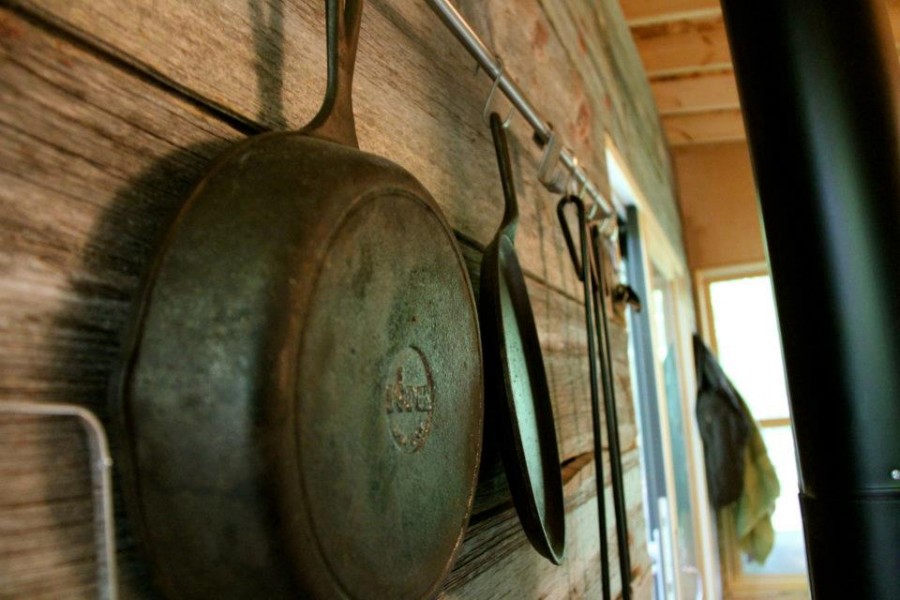
Photo by Tona Williams.

Photo by Tona Williams.

Basically, if you’re ever lucky enough to visit, expect to earn your stay there—Jenny doesn’t screw around and there is always work that can be done. Until it’s time for whiskey and/or poetry, anyway. There are also added perks of mooing cows off in the distance at night, Carney family homemade maple syrup, and (new!) black walnuts meticulously cracked and jarred for consumption, and the fact that you will get to hear stories about how trees are incredibly smart and why fireflies blink. Believe me, if I could rent Jenny and her cabin out to my fellow nature-deprived city-dwelling friends, I would. Until then, I would recommend looking up some plans online and adding “build a cabin” to your 2014 To Do List. It’ll feel like entering Dr. Who’s magical phone booth.

Coffee heating on the cast iron stove, reading on the porch. (Photo by Tona Williams)

Coffee heating on the cast iron stove, reading on the porch. (Photo by Tona Williams)

Xanadu (inside). The cabin is tiny, but once again, Jenny designed multi-purpose furniture. The opposite side of the space has two stacked wooden boxes store bedding and come apart to form beds, and a frame drops down from a wall to create a third, full-sized bed. We've slept 4 in here and been a-ok. I know. Swoon! (Photo by Tona Williams)

Xanadu (inside). The cabin is tiny, but once again, Jenny designed multi-purpose furniture. The opposite side of the space has two stacked wooden boxes store bedding and come apart to form beds, and a frame drops down from a wall to create a third, full-sized bed. We’ve slept 4 in here and been a-ok. I know. Swoon! (Photo by Tona Williams)

More than a leg to stand on: Hands-on fields that combine art, science, and even a little fiction

A leg up.

A leg up! Plaster molds are created from patient casts. The positive is then used as the model to mold and fit an orthotic device.

I recently completed a 10-day road trip around the South that included Illinois, Tennessee, Alabama, Mississippi, and Louisiana. This little adventure, which has become an annual event that restores my sanity, generally involves many cemetery stops, crumbling shacks worth pulling off the road to gaze at, amazing little restaurants and bars (oh, cheesy grits and Sazeracs, you have obliterated me with your love), some kayaking in the bayou, and lord knows a million other delightful events. I’m excited to report that for the first time ever, this particular trip also included an interview with some orthotics and prosthetics makers in New Orleans who just happened to be one of the winners of ToolMade’s Sears-Craftsman Tool Giveaway.

Clare shows a custom solid ankle-foot orthoses she fabricated using a vacuum form technique at the clinic.

Clare shows a custom solid ankle-foot orthoses she fabricated at the clinic.

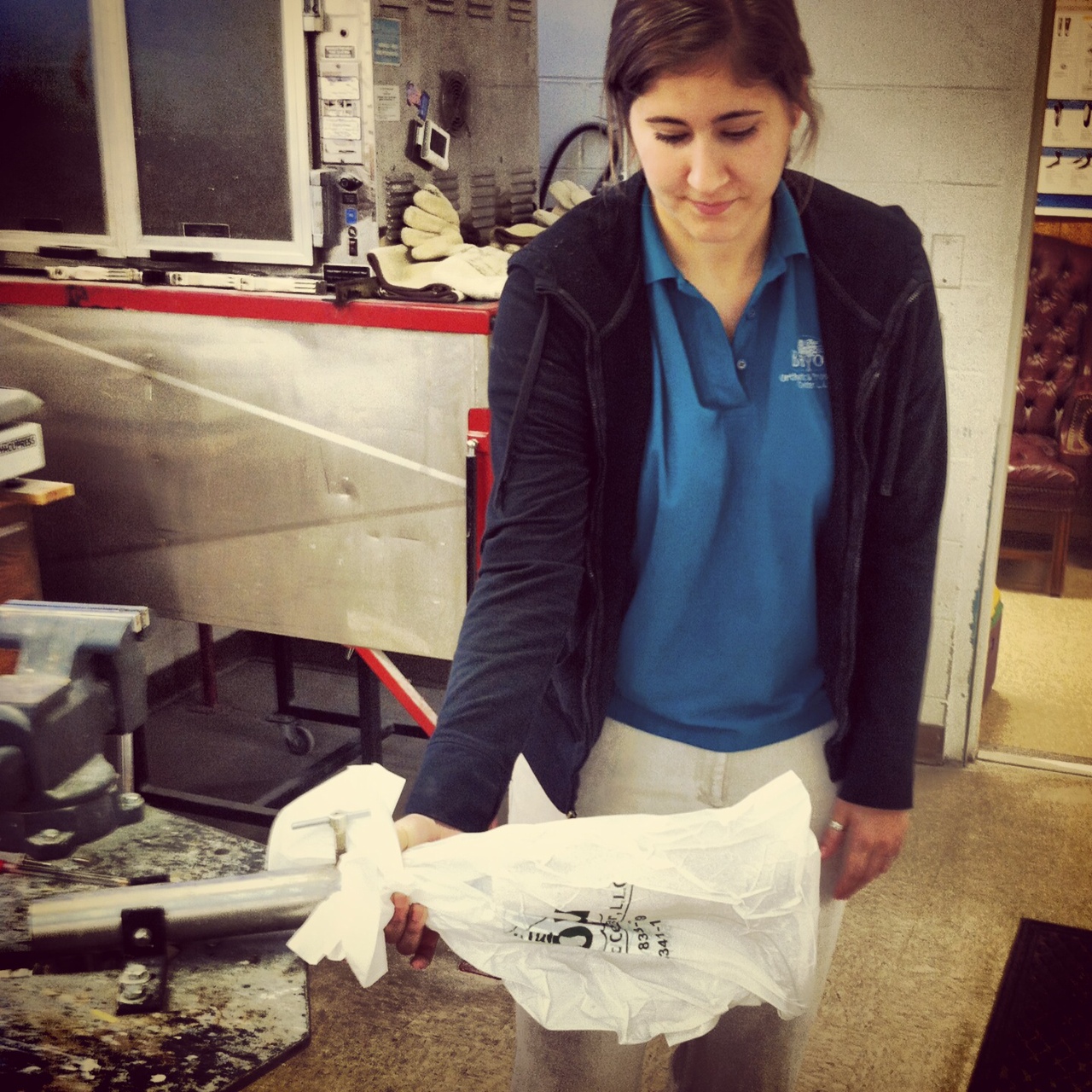
After a plaster cast is made for a client, a plastic sheet is vacuum formed for an exact fit. Because plastics are now used, a heat gun can make tiny adjustments when needed. Yes, that's a bag. No, that's not what Clare usually uses.

After a plaster cast is specially made for a client, a plastic sheet is vacuum formed for an exact fit. Because plastics are now used, a heat gun can make tiny adjustments when needed as well. Yes, that’s a bag. No, that’s not what Clare usually uses.

Prostheses are damned fascinating to me and I’m telling you, they should be to you as well. In my early 20s, I had some unexpected health issues that almost made me lose one of my precious gams, so when things were scary, I made a point of researching some heroes with prosthetic limbs to try and keep a positive attitude–it’s crazy what people can do despite their perceived handicaps. I get that this is a specific experience that initially lead to my interest, but you don’t have to dig far to find something that will blow your mind–I mean, some of the earliest and also most recent innovations read like science fiction. Designers from a wide range of backgrounds are getting better and better at creating limb stabilization and replacement devices due to new technologies, tools, and materials, and that’s excellent news considering that there are nearly 2 million people with artificial limbs in the U.S. (about 185,000 amputations in the U.S. alone each year, and that number is climbing).

I'm not sure how well this picture illustrates this, but if you look closely, you can even see the grooves of the skin on the foot. The accuracy matters not only to the fit but to how realistic a device can be made to look for the client.

I’m not sure how well this picture illustrates this, but if you look closely, you can even see the grooves of the skin on the foot.

Prostheses! It is imparitive that these fit exactly, and sometimes multiple devices will have to be created just for the fitting process. The plastic is thermoset plastic, which starts as a liquid and is impregnated with fabric. The inside is made of carbon fiber for added strength.

Prostheses! Different heights and body types sometimes require multiple devices to be created just for the fitting process. The plastic is thermoset plastic, which starts as a liquid and is impregnated with fabric. The inside is made of carbon fiber for added strength.

When I had an opportunity to interview Clare Wiegand and Paul Beaudette at the Bayou Orthotics and Prosthetics Center in Metarie, Louisiana, I jumped at the chance. Yeah sure, you can run with that pun. First, some definitions to distinguish these devices/fields:

Orthosis (orthotic device): “An externally applied device used to modify the structural and functional characteristics of the neuromuscular and skeletal system,” or basically, something bracing what is already there.

Prosthesis (prosthetic device): “An artificial device that replaces a missing body part lost through trauma, disease, or congenital conditions.”

An orthotist fabricates and fits custom-designed external orthopedic braces, and a prosthetist creates, designs, and custom-fits artificial limbs. Both require a lot of time evaluating and following-up with patients as well.

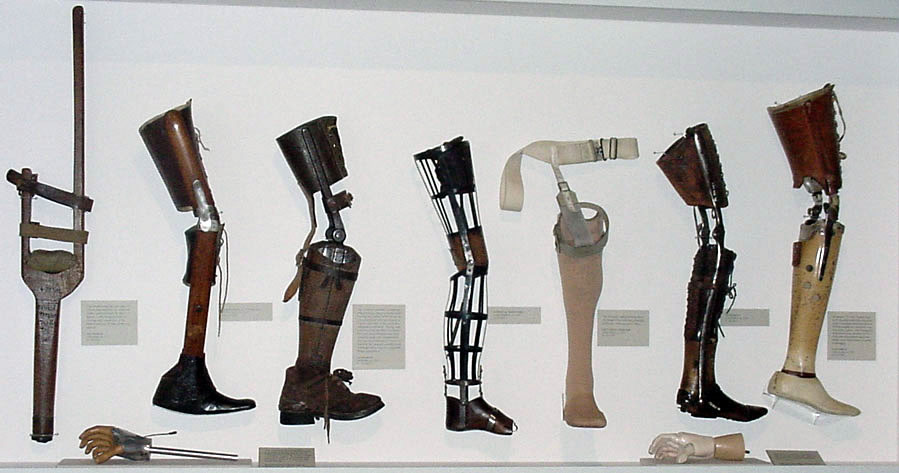
A brief history of legs past.

A brief history of legs past.

As one might guess, splints and braces were the first orthotic devices (also called orthoses). With the Civil War came a desperate need for massive quantities of prosthetic limbs (prostheses) and those experimenting with the creation and attachment of limb replacements became recognized as legitimate health professionals at that time–before this period, people had to fashion them from pieces of wood by themselves. These fields have grown and become increasingly sophisticated with every major war, and more recently have boomed due to lifestyle and health changes, including an ever-increasing aging population and a dramatic increase in diabetes, obesity, and heart disease.

J.E. Hangar Company, artificial leg production workshop, post Civil War. The company survives today! (National Photo Company Collection)

J.E. Hangar Company, artificial leg production workshop, post Civil War. This was serious technology at the time. Prostheses were made of whittled barrel staves and metal. The company survives today! (National Photo Company Collection)

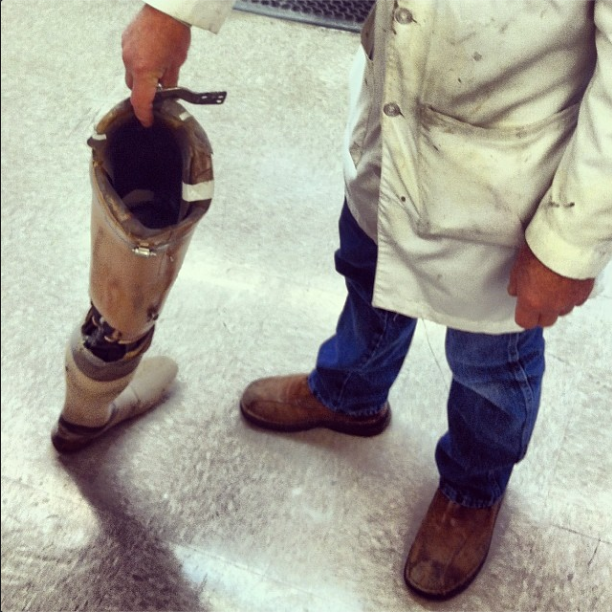
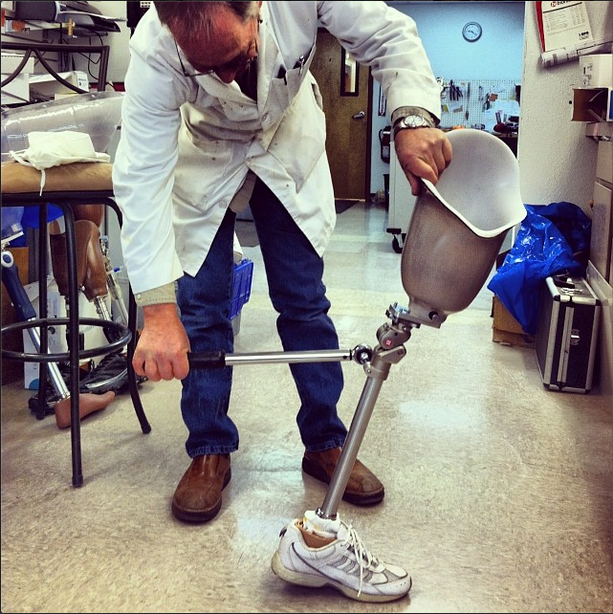
Paul, who has been making prostheses for decades, shows off a wooden leg that he keeps in the office as a reminder of days past.

Paul, who has been making prostheses for decades, shows off a wooden leg that he keeps in the office as a reminder of days past.

Clare, who has been making both orthoses and prostheses since 2007, was my contact at the clinic, so I asked her what tools would be useful. They use lots of drills, drill bits, heat guns, belt sanders, pliers and torque and allen wrenches. I picked her up a variety of Craftsman tools within the contest budget, consisting of:

  • (2) 4 piece Pliers Sets (diagonal, slip joint, arc joint, long reach long nose, wide jaw, duckbill, linesman, and regular long nose)
  • 21 Piece Titanium Coated Drill Bit Set
  • 17 Piece Screwdriver Set
  • 19.2-Volt C# Cordless Drill/Driver
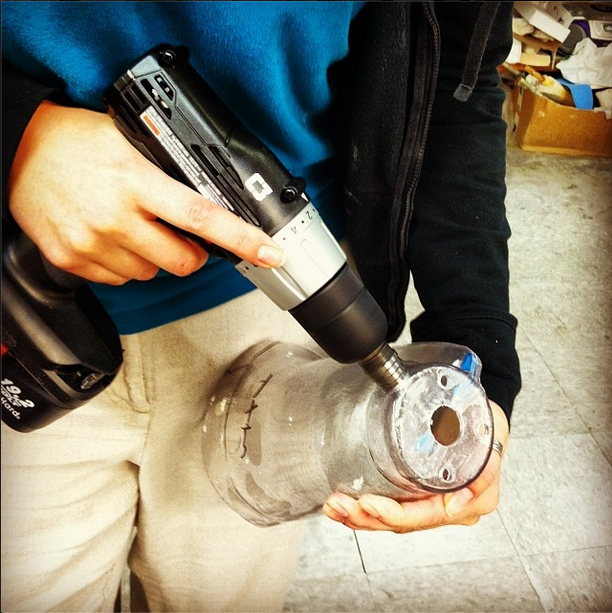
Drills are used often and need bits that can drill through carbon fiber. Step bits are often used to create wider openings.

Drills are used often and need a wide range of bits, including step bits for wider sockets.

Adjustments are crucial. There are wrenches and pliers galore around this place.

Adjustments are crucial. There are wrenches and pliers galore around this place.

I was toured through the different stations for an overview of how knee, ankle and foot devices were created, and given a look at what some of the older models looked like. The tool stock used for making these devices has changed quite a bit in recent decades—Paul, who has been making prostheses for over 40 years, explained how wooden prostheses used to be made entirely out of hand tools—sharp chisels which would be pulled upward to shape a leg are now replaced by routers, for example. The materials are also very different and consist of things like carbon fiber and plastics, making them much easier to adjust for a precise fit for each patient. Of course, the patients have also changed over time due to both an increase in illnesses as described above, but also due to fewer industrial accidents—at least some people seem to be paying attention to OSHA?

USA's paralympic swimmer Jessica Long. (Press Association via AP)

USA’s paralympic swimmer Jessica Long. (Press Association via AP)

If you’re not sure what to do with your time on this planet and this topic is at all interesting to you, seriously consider looking into these fields, which are described good career options for those who want to be an artist/bio-mechanist/engineer/medical practitioner. Why limit yourself, right? I would also add that folks who care about others and are interested in hands-on work and tools could certainly find a niche here. There is a projected 25% increase in the number of people needing orthopedic braces due to paralysis, deformity or orthopedic impairments by 2020. And if you’re more interested in creating prostheses than orthoses, that need is expected to grow 47% in the same timeframe. Wow. Yeah, I’m really selling it. Because it’s so damned important.

What my prosthetic limb would look like (painted by Tim Beck).

What my prosthetic limb would look like (painted by Tim Beck).

For more info on innovations in the field and ways people are advancing mobility, check out some great links here:

Targeted muscle reinnervation (TMR):  Your brain controls the muscles in your limbs by sending electrical commands down the spinal cord and then through peripheral nerves to the muscles. http://science.howstuffworks.com/prosthetic-limb5.htm

Photos of the latest in prosthetic limb technology: http://www.smartplanet.com/photos/the-latest-in-prosthetic-limb-technology-photos/

Stand-up Mobilization Device (this is a bit of an offshoot, but a mind opener): http://www.wimp.com/newdevice/

More about careers in these fields (includes a list of programs throughout the country towards the end of the brochure): http://www.opcareers.org/assets/pdf/Turnkey_Brochure.pdf

Make it art: http://www.thealternativelimbproject.com

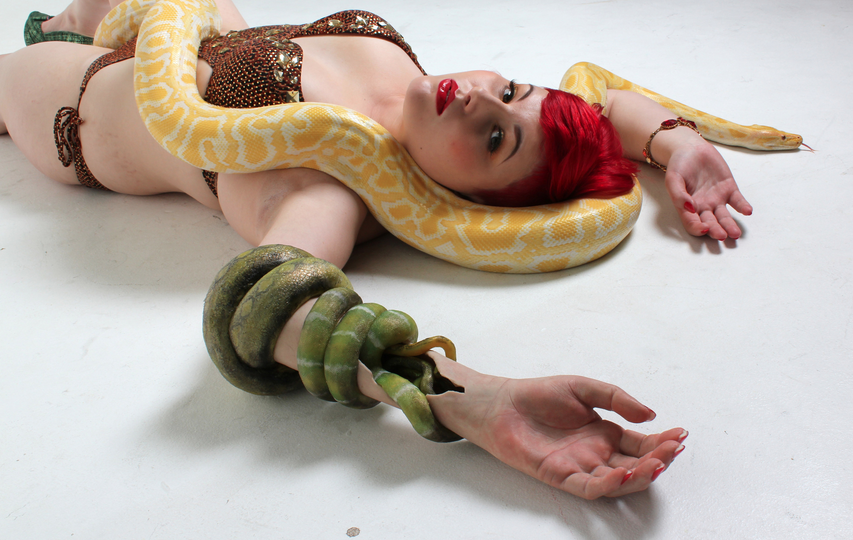
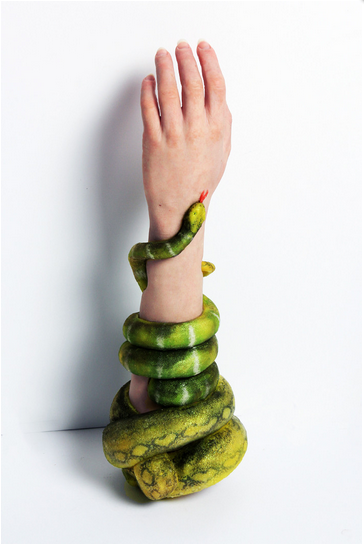
In case there was any doubt about whether prostheses could be sexy. Jo-Jo Cranfield wearing the snake arm created by Sophie de Oliveira. Please check out the Alternative Limb Project when you have a few minutes.

…and just in case there was any doubt about whether prostheses could be sexy. Jo-Jo Cranfield wearing the snake arm created by Sophie de Oliveira. Please check out the Alternative Limb Project when you have a few minutes. http://www.thealternativelimbproject.com

Screen Shot 2014-01-21 at 3.18.48 PM